
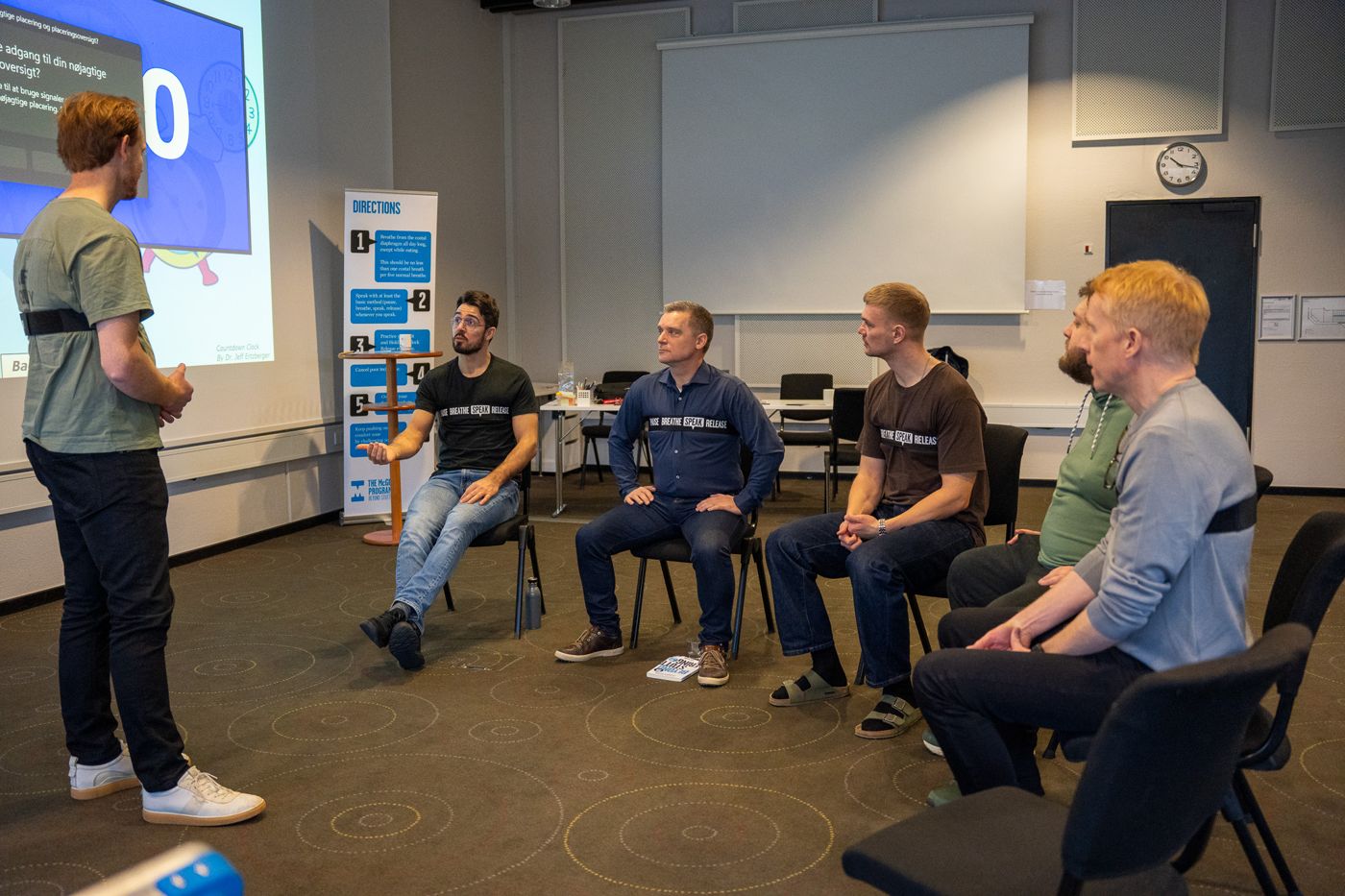
Perhaps you've been thinking about a stuttering course for years. Perhaps you've only just discovered they exist. Either way you probably have the same questions: what actually happens on a course like this? Will I have to speak in front of other people? And is it for someone like me?
Here is an honest walk-through of what a McGuire course is like, day by day. You'll also find out what it asks of you, and who it isn't right for. We don't promise a cure. We tell you what you're signing up for.
What is a stuttering course?
A stuttering course is a course where you work intensively on your stutter over a few days, together with other people who stutter. That's different from seeing a speech and language therapist, which typically means conversations and exercises over a longer period. You can read more about the difference in the article on a speech and language therapist for adults or a stuttering course.
The McGuire Programme is a course for anyone aged 14 or over who stutters. More than 5,000 people have completed the programme. The course lasts four days, from Thursday 08:00 to Sunday 14:00, and the days can be up to 16 hours long.
A stuttering course for adults and teenagers, taught by people who stutter
All the instructors on a McGuire course stutter themselves and have been through the course. They don't ask you to do anything they haven't done. They know what it feels like to be stuck in a block with a queue behind you, and they know what it takes to move on.
It also means that for four days you're with people you don't have to explain anything to. Many adults have never talked openly with another person who stutters. Here, everyone does.
The four days of the course
Each day has its own theme, and the days build on one another.
Day 1: The technique
Thursday begins with an interview. After that you learn costal breathing, a new way of breathing that is the foundation for the rest of the course. You're introduced to the checklist, and before the day is over you give your first speech in front of the group.
Day 2: Out into the city
On Friday you work with deliberate dysfluency, where you go into the thing you usually avoid, on purpose. You learn Hit and Hold and Block release, which help you into and out of the words that get stuck. And then you go out into the city. Together with an experienced course member, you approach 100 people. That sounds like a lot, and it is. But you don't go alone, and this is where the technique moves out of the room and into real life.
Day 3: Your turn
Saturday is about phone calls and reading aloud, two things many of us have avoided for years. You take part in John Harrison's workshop, and you give a public speech in the city.
Day 4: Home with a plan
Sunday is about life after the course. You set goals, and we talk about everyday life, about relapse and about the support you can draw on. Before the course ends at 14:00, you give your farewell speech.
The method in The McGuire Programme
The McGuire Programme works on two sides of stuttering at the same time:
- The physical side: your breathing and the techniques you use when a word gets stuck.
- The mental side: the fear of stuttering and the habit of avoiding words and situations.
That's why you don't only practise in a room. A technique that only works among friendly people on a course won't help you on the phone on Monday morning. You need to have tried it out where it's hard, while you have the group behind you.
We call the goal eloquence. That isn't the same as fluency. Eloquence is saying what you want to say, when you want to say it. Some people still stutter now and then after the course. The difference is that they have tools to get through it, and they no longer plan their day around avoiding. If you'd like more of the background, read our guide to stuttering in adults.
After the course: follow-up and daily practice
Four days don't change a habit you've had all your life. They give you the tools and your first experiences of using them. The rest happens at home. The daily practice afterwards is what keeps the new habits alive.
You're not left alone with it. After the course you get lifelong support and guidance, and you become part of a network of people who stutter. We also talk, while you're still on the course, about what to do if you have a relapse.
Who is a stuttering course right for, and who is it not right for?
The course is right for you if:
- you're 14 or over and you stutter
- stuttering makes you turn down things you would like to do
- you're ready for four long days and for doing things you usually avoid
- you'll keep practising every day, after the course is over too
It's less of a fit if:
- you're looking for a quick fix with no practice afterwards
- you expect the stutter to be gone by Sunday afternoon
- you've never stuttered before and have suddenly started as an adult. In that case, talk to your doctor first.
If you're not sure whether a course is the right thing for you just now, that's completely fine. There are other routes, and we've gathered them in the article on stuttering treatment for adults.
Price, locations and booking
The course costs DKK 18,000 as a one-off payment. Courses are held in Aarhus, Malmö and Oslo, and you can see the dates of the upcoming courses on the front page. The McGuire Programme also runs courses in other countries.
There is no online booking. You call or write to us, and we have a chat about where you are and whether the course is right for you. You'll be talking to someone who stutters themselves, and calling doesn't commit you to anything.
Frequently asked questions
How long does a McGuire stuttering course last?
Four days, from Thursday 08:00 to Sunday 14:00. The days can be up to 16 hours long, so expect the course to take up all your time while it's on.
Is there a stuttering course for adults?
Yes. The McGuire Programme is for anyone aged 14 or over who stutters, so there's room for both teenagers and adults.
What does The McGuire Programme cost?
The course costs DKK 18,000 as a one-off payment. After the course you get lifelong support and guidance.
Will I have to speak in front of other people on the course?
Yes. You give your first speech in front of the group on the very first day, and on the third day you give a public speech in the city. You do it alongside other people who stutter, and with instructors who have stood in the same place.
Will I stop stuttering after the course?
We don't promise that, and there is no cure for stuttering. You get techniques and experiences that give you control of your speech, and the goal is that you can say what you want, when you want. That requires you to keep practising after the course.
Other places to find help and community
McGuire is one option among several. These are good to know about, whatever you choose.
- STAMMA – the British Stammering Association – Information, a free helpline and webchat, and groups for people who stammer.
- International Stuttering Association – Umbrella organisation for national stuttering associations. Find the association in your country.